

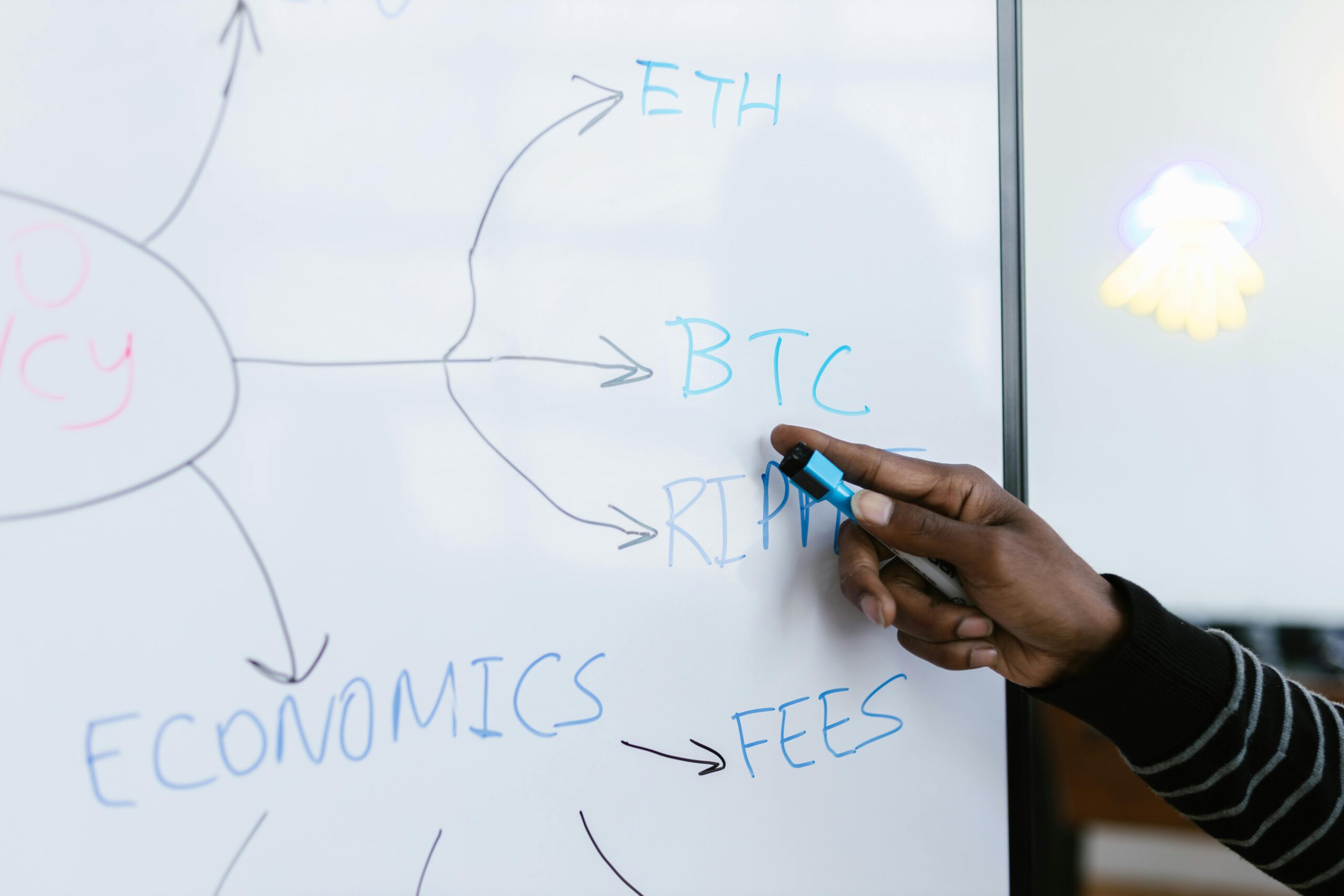
What is blockchain? Few technologies get named more often or understood less. For years it was sold as either the foundation of a new financial system or a fix looking for a problem, and both labels fit at different moments. The honest 2026 read sits in between. Blockchain is foundational plumbing. It now reshapes a handful of high-value workflows across finance, supply chains, and digital identity. Meanwhile, hard experience has trimmed back the wild promises of the 2017 and 2021 hype cycles. So the market today rewards specific wins, not slogans, and the sector is worth a projected $67.4 billion this year.
What Is Blockchain, Defined
What is blockchain at its core? It is a shared, decentralised ledger that records transactions so no single party can quietly rewrite them. Most databases keep one master copy under one administrator, like a bank ledger or a government registry. Blockchain swaps that single copy for thousands of identical copies, held at once by independent computers called nodes across the world. So no one entity owns the record. To fake a past entry, you would need to rewrite it on most of those machines at the same time, which stays computationally out of reach.
How a Blockchain Works
What is blockchain doing under the hood? It bundles transactions into batches called blocks. Each block carries recent transactions, a timestamp, and a cryptographic fingerprint, the hash, of the block before it. Because every block points back to the last one, the blocks lock into a chain. Change a single character in an old block and its hash shifts, which snaps the link to the next block, and the next. So every node spots the tampering at once.
Adding a block needs the network to agree the transactions are valid. Bitcoin uses Proof of Work, where nodes burn computing power on hard puzzles to earn the right to add a block. Ethereum switched to Proof of Stake at its 2022 Merge, where validators lock up crypto as collateral and lose it if they cheat. Proof of Stake runs on roughly 99 percent less energy, so it now anchors most new blockchain design.
Smart Contracts, the Bigger Leap
What is blockchain automating through code? Its second and arguably larger innovation is the smart contract. A smart contract is a self-running program on a blockchain that fires predefined actions once set conditions are met, with no middleman. Picture a vending machine. You insert the right amount, pick an item, and it drops, no clerk required. Smart contracts bring that logic to money. One can release collateral the moment a loan clears. Another can pay a supplier once a shipping document checks out. These are live tools now, not demos. JPMorgan’s Onyx network has pushed more than $700 billion through a permissioned chain for intraday repo. Major institutions keep building on the same idea, as industry reporting on tokenisation and DLT adoption shows.
Public, Permissioned, and Hybrid Chains
What is blockchain like in its open and closed forms? Public chains such as Bitcoin and Ethereum let anyone join, submit a transaction, and read the full history. They put censorship resistance and transparency first. Permissioned chains, like Hyperledger Fabric inside enterprise consortia, vet who takes part and can hide transactions from outsiders. They run lighter consensus because the members already trust each other. So banks have mostly settled on permissioned or hybrid setups, since know-your-customer and anti-money-laundering rules clash with fully anonymous public access. Regulation pushes the same way, and the GENIUS Act and MiCA frameworks now steer how public rails plug into regulated finance, a shift detailed in recent market analysis.
What Is Blockchain Used For in Finance
What is blockchain solving for real businesses? Four use cases stand out as commercially mature. Cross-border payments lead. Blockchain trims remittance costs by up to 60 percent on World Bank figures. The blockchain remittance market should reach $156 billion by 2026. We track that space in our coverage of digital and mobile payments. Stablecoins ride blockchain rails for dollar payments, and their settlement role keeps expanding, as payments coverage of the stablecoin stack makes clear. Trade finance comes next, a $1.1 trillion market still run on paper and bilateral trust that cryptographic records can replace. Tokenisation lands third, turning real estate, private equity, and commodities into digital tokens that allow fractional ownership and round-the-clock trading. Digital identity is the fourth, letting people share only the attributes a transaction needs.
What Is Blockchain Unable to Do
An honest read means naming the gaps too. Blockchains are not faster than ordinary databases for most jobs. They are not cheaper to run when decentralisation is not needed. They stop tampering at the ledger layer, not fraud at the application layer. And the scalability trilemma still constrains engineers. No chain has yet hit decentralisation, security, and high throughput all at once. Layer 2 networks help, pushing thousands of transactions per second on top of slower base chains like Bitcoin’s seven. So the right test is never the promise. It is the measurable result: less reconciliation, better auditability, faster settlement, and new programmable products. The decentralised side of this story sits in our DeFi reporting.
What Is Blockchain Becoming Next
What is blockchain turning into from here? Less a revolution, more a quiet upgrade to the rails finance already runs on. PwC estimates the technology could add $1.76 trillion to global GDP by 2030, and roughly 90 percent of US and European institutions already explore it in some form. The winners will not be the loudest projects. They will be the teams that pair blockchain with real workflows and show the numbers. Regulators are now actively shaping that approach, as the UK and Singapore fintech accord makes clear. So for anyone weighing a build, an investment, or a career, watch where verified settlement and tokenised assets move from pilot to production.
