

Author: Mr Vignesh Coumarane, Founder & Product Architect, InvestEd
AI financial guidance has a trust problem that no amount of cleaner dashboards will fix. Most fintech apps built a great data layer. Clean dashboards, real-time balances, spending breakdowns, transaction history going back years. It works. Then they stopped. The assumption underneath most of these products is simple: give someone a clearer view of their money and you have helped them make better decisions with it. Ten months of building taught me those are two very different problems, and the gap between them is where the real work lives. That gap is exactly where AI financial guidance should earn its place, and where most tools quietly give up.
The Display Problem vs the Decision Problem
Showing someone their data is a display problem. It needs a good interface, reliable data connections, and clear visualisation. Fintech has largely solved that.
Helping someone reason through a financial decision is a different architectural problem. It means understanding what the person is trying to decide, running the math on their specific scenario, and surfacing the trade-offs in a way they can act on. Most apps do not attempt this. Not because it is impossible, but because it is harder, and it demands a different design philosophy from the ground up. AI financial guidance lives entirely inside that harder problem.
So the category fills up with apps that track what happened well and stay almost silent on the question that matters most: what should I do next? Modern budgeting and wealth tools have reached toward this, but mostly they hand the user another swipe rather than a reason to think. Real AI financial guidance starts where the dashboard ends.
Why AI Financial Guidance Keeps Failing the Trust Test
The industry’s answer to this gap has been AI. Feed the data into a model, generate personalised recommendations, scale the advisor. In theory it sounds right. In practice it keeps hitting the same wall, because users do not trust it enough to act on it.
The reason is architectural, not cosmetic. AI-driven fraud detection earns trust because it works in the background and removes something users fear. It protects without asking for anything. Proactive AI financial guidance is visible, and it asks users to hand over something they guard closely: their judgment on money decisions. Those are different asks, yet the industry keeps treating them as one.
Survey data backs this up. A recent TD Bank study reported by the ABA found roughly two-thirds of consumers are comfortable with AI handling behind-the-scenes tasks like fraud detection and spending tracking, while trust drops sharply once AI makes autonomous calls on high-stakes decisions. So the trust gap is not really about AI. It is about what the AI is asked to do, and whether the user can see into its reasoning well enough to believe it.
The Architecture of Genuine AI Financial Guidance
The approach I have taken with InvestEd separates the math from the recommendation entirely. The simulation layer runs deterministic calculations on the scenario the user describes. No bank connections, no behavioral inference, no account history required. The AI wraps around that math to make it navigable: routing users toward the right question, explaining what the numbers mean, and surfacing which levers move the outcome.
So the AI does real work. It reads the scenario, makes sense of the trade-offs, and brings clarity where the user does not have it yet. But it is not the layer making the call on someone’s money. That stays with the user, and that is deliberate.
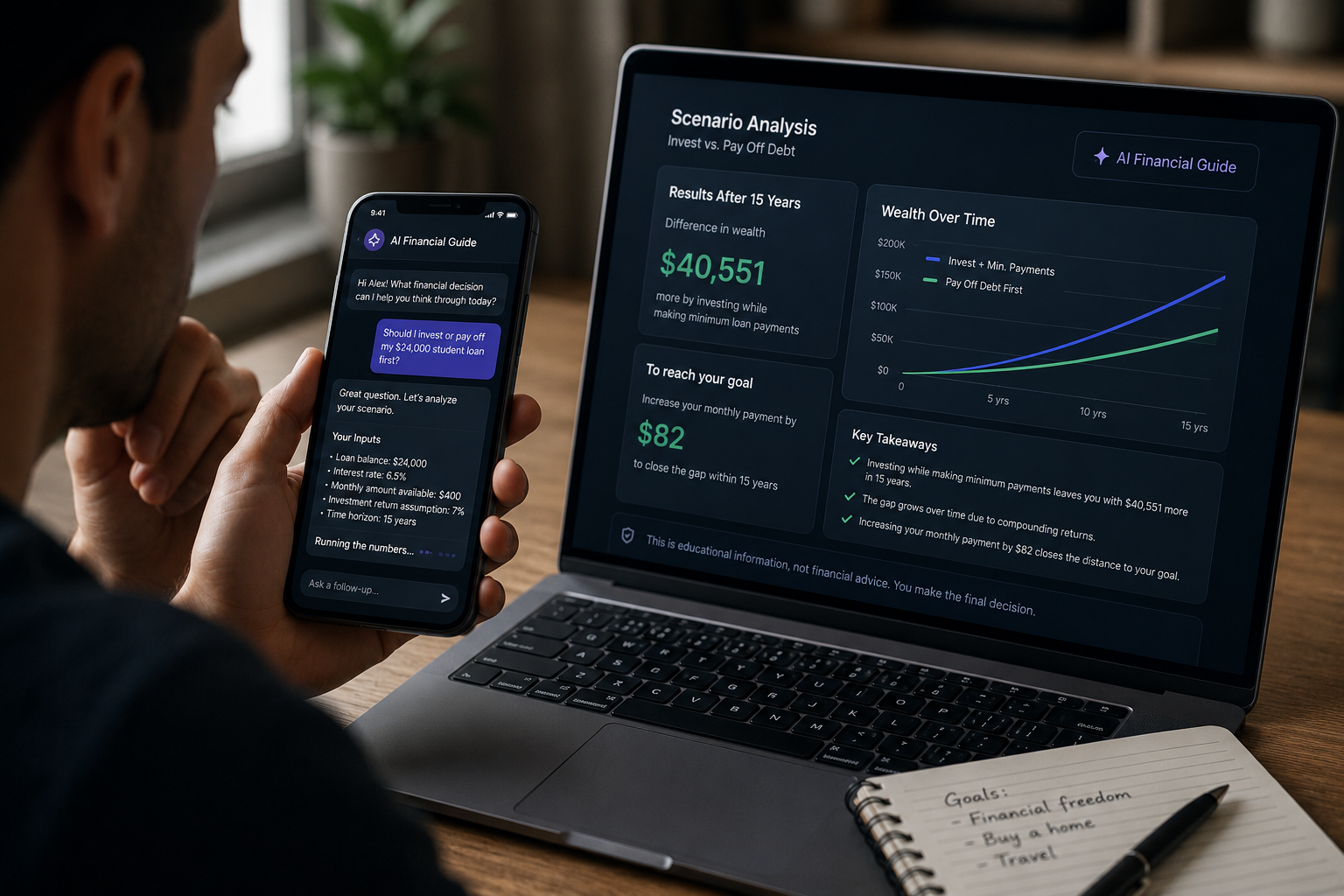
Here is a concrete example. A user arrives with a $24,000 student loan at 6.5% and $400 a month to deploy. He wants to know whether to invest alongside repayment or clear the debt first. The math produces a $40,551 gap between the two strategies over fifteen years. The model’s job is not to pick one. Instead, it helps him understand what drives that gap, and that an extra $82 a month closes his remaining distance to his declared goal. He leaves with clarity, not a verdict from an algorithm. That distinction is the whole point of AI financial guidance done well: the AI brings clarity to the question, the math answers it, and the user decides.
Why Most Apps Still Fall Short
The underutilization numbers tell the same story from another angle. Predictive balance tools, savings insights, and cash flow forecasting, all practical features with real value, see adoption in the low twenties despite people banking online several times a week. The reason is not awareness. It is meaning. The Financial Health Network found that few households used AI tools for personal finance in 2024, with low trust and weak familiarity near the top of the list.
There are more wealth and budgeting apps now than at any point in history, and most are honestly trying to make life easier. But easier is not the same as better. A feature that surfaces a number and moves on is not building a financial habit. It is building a dashboard nobody opens. When the app never creates a moment where the user pauses and reasons through something, even for sixty seconds, it becomes one more swipe in a sea of notifications. Utilisation follows meaning, not convenience. That is the bar AI financial guidance has to clear.
So the apps that close this gap will treat the decision as the product. Not the data, not the interface, not the AI capability. All three serve one thing that real AI financial guidance is built around: helping a person think clearly before they commit.
Transparency Is the Real AI Financial Guidance Moat
Question seven on most fintech research surveys asks some version of the same thing: what happens when AI explains its logic to users? The answer, consistently, is that trust and loyalty climb. Industry trust research from RFI Global points the same way, since institutions build confidence by clearly explaining how their AI works and how data is protected.
This makes sense from the user’s side. Most people using financial AI sit somewhere between mild uncertainty and real anxiety about money. They do not need a smarter recommendation. They need confidence that the output is trustworthy. When a user can trace every number back to a formula and an input they supplied themselves, the relationship with the tool shifts. Even if they never click through to verify it, knowing they could is the point. It moves from “I hope this is right” to “I can see why this is right.” That is a different kind of loyalty, and a black-box model cannot easily copy it.
So the apps that figure this out first will not just post better engagement metrics. They will keep users who come back for consequential decisions, not just to check a balance. Transparent AI financial guidance is the moat.
What Comes Next
The gap between data display and genuine AI financial guidance is real, measurable, and still largely unaddressed. The tools to close it already exist. Deterministic simulation is not new. AI interpretation is not new. The missing piece has been a design philosophy that treats the decision, not the data, as the core product. The broader shift toward AI across finance functions makes that philosophy easier to ship than it was even a year ago.
Ten months in, the thing I am most confident about is this. The financial tools people will trust with their most consequential decisions are the ones that give judgment back to the user, not the ones that try to replace it. That is the promise of AI financial guidance, and it is still wide open.
About the Author
Vignesh Coumarane is the founder and product architect of InvestEd (the-invested.com), a simulation-native financial decision platform. He is a data analytics professional, LinkedIn Top Voice for data, and the author of the Financial Decision Intelligence Framework (FDIF), published in 2026.
