

Every time you tap your phone at a coffee shop, split a bill with a friend, or pay for a subscription online, you take part in the digital payments market. This market is the infrastructure that moves value between parties in electronic form, and in 2026 the digital payments market is the largest, fastest-growing, and most consequential segment of the global fintech industry. The scale is hard to overstate, yet the machinery behind a single tap stays almost entirely out of view.
Total transaction value in the digital payments market will reach $26.89 trillion in 2026, up roughly 11.7 percent from the prior year. To put that climb in context, the figure sat at just $1.7 trillion back in 2014, a compound annual growth rate above 27 percent across eleven years. That pace is not driven by technology for its own sake. Instead, it reflects an irreversible shift in how people and businesses prefer to transact: faster, cheaper, more convenient, and increasingly invisible.
Digital Payments Market by the Numbers in 2026
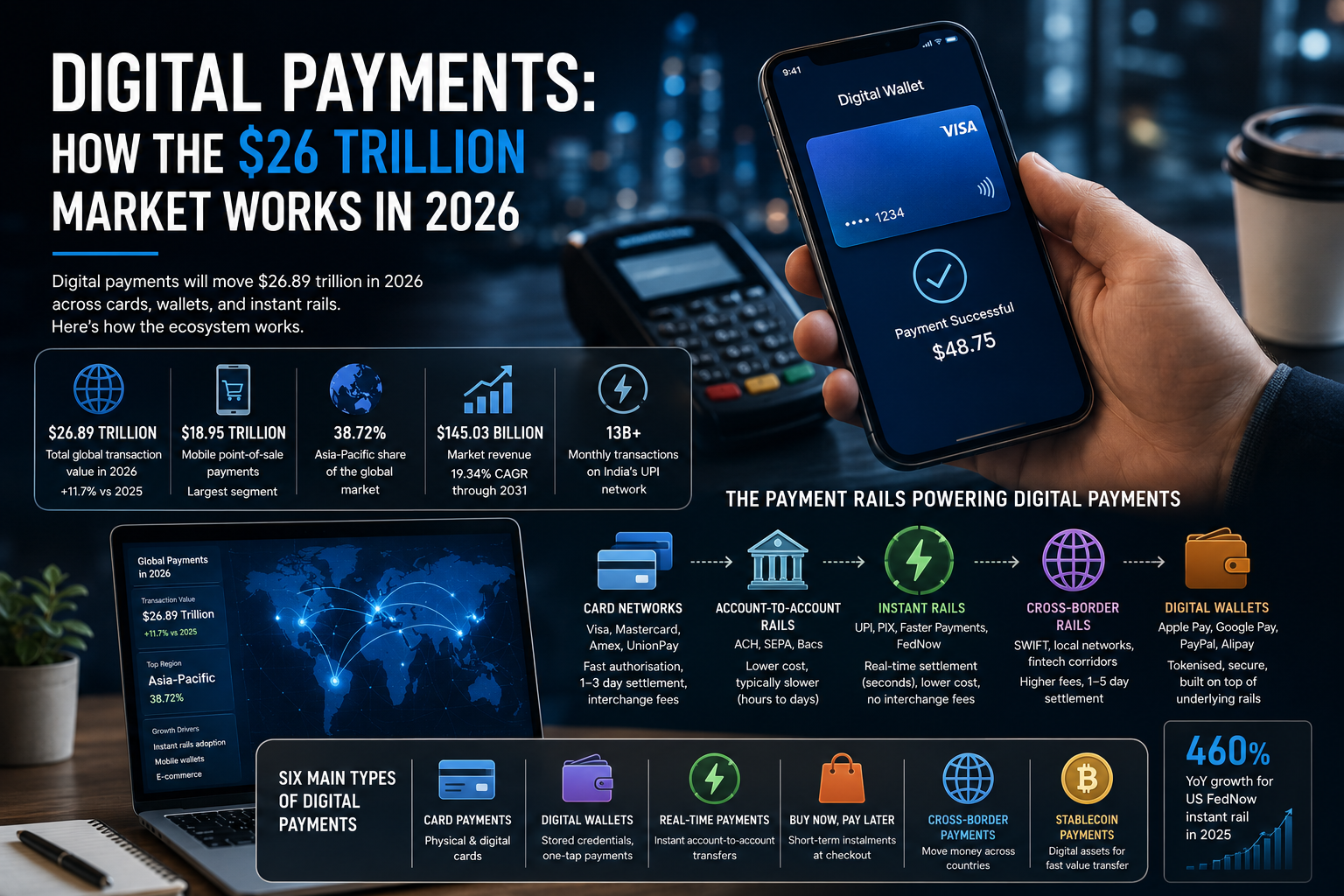
Before the mechanics, a few figures show why the digital payments market now sits at the centre of finance:
- $26.89 trillion in total global transaction value for 2026, the headline figure from Statista.
- $18.95 trillion flowing through mobile point-of-sale payments, the single largest segment.
- 38.72 percent of the global digital payments market sits in Asia-Pacific, the leading region by share.
- $145.03 billion in market revenue, growing at a 19.34 percent CAGR through 2031.
- Over 13 billion monthly transactions run through India’s UPI network alone.
- 460 percent year-on-year growth for the US FedNow instant rail during 2025.
What Counts as a Digital Payment
A digital payment is any transfer of value between two parties that is initiated, transmitted, and settled electronically rather than through physical cash or a paper cheque. The category therefore stretches across an extraordinary range of mechanisms. At one end sits a contactless card tap that clears in a fraction of a second. At the other sits a cross-border wire that may take two days to land.
What unites them is simple: no physical currency changes hands. In practice, the digital payments market includes wallet apps, account-to-account transfers, buy now pay later, cryptocurrency transfers, and credit, debit, and prepaid cards. Each behaves differently because each rides a different underlying rail. The friction, the fees, and the speed you experience all trace back to which rail a given payment uses.
How Payment Rails Move the Money
The path a payment travels is called a payment rail, and understanding the rail explains why these transactions behave so differently from one another. Card networks such as Visa and Mastercard remain the most widely used rails in developed markets. When you tap a card, the transaction passes through your bank, the network, and the merchant’s bank, clearing in seconds but settling over one to three days. The network also charges an interchange fee on each transaction, a cost quietly baked into retail prices everywhere.
Account-to-account payments take a different route, moving money straight from one bank account to another and skipping the card networks. Historically this was slow, with US ACH transfers taking days to settle. The defining trend of 2026, however, is the surge of instant account-to-account rails that settle in seconds. India’s UPI, Brazil’s PIX, the UK’s Faster Payments, and the US FedNow service all clear in real time or close to it. Because these rails carry no interchange fee, they are structurally cheaper than cards, which is one reason this market grows faster wherever the infrastructure exists.
Digital Payments Market Splits Into Six Types
The landscape in 2026 sorts into six broad categories. Card payments, both physical and tokenised, still dominate most developed markets across the Visa, Mastercard, American Express, and UnionPay networks. Digital wallets such as Apple Pay, Google Pay, and PayPal store credentials on a device and trigger a payment with one gesture. As our breakdown of mobile payment platforms shows, Apple Pay holds roughly a 15.9 percent in-store US share while Google Pay has climbed to 8.9 percent.
Real-time payments, powered by the instant rails above, are the fastest-growing slice of the digital payments market. Buy now pay later splits a purchase into short, usually interest-free instalments and now appears at checkout almost everywhere. Cross-border payments carry the highest fees and the most friction, which is why fintech disruption has hit them hardest; Wise built its business by undercutting the hidden charges traditional banks bury in the exchange rate. Stablecoin payments round out the list as the newest entrant, using blockchain rails to move dollar-denominated value across borders at near-zero cost, a shift we track in our coverage of business banking on stablecoin rails.
Processors, Gateways, and Acquirers Explained
Between the moment you initiate a payment and the moment a merchant gets paid, several intermediaries do quiet work. Most digital payments pass through three of them before they settle. A payment gateway captures and transmits payment data from the merchant’s checkout, with Stripe, Square, and Adyen all playing this role. A payment processor then handles the authorisation request, checking with the card network and issuing bank that the funds exist and the payment is valid.
Finally, an acquirer is the institution that holds the merchant’s account and receives the settled funds. Many modern fintech stacks fold these layers together. Stripe, for instance, acts as gateway, processor, and acquirer for most of its merchants, which is precisely why its integration feels so effortless. That consolidation is one reason embedded finance has spread so quickly across the market, a trend we explore in our look at embedded finance in 2026.
Digital Payments Market: The Invisible Future
The clear direction of travel points toward more automation, lower cost, and the quiet disappearance of the payment itself as a conscious act. The next decade of the digital payments market will be defined less by new apps and more by payments you never notice making. Amazon’s Just Walk Out stores, where shoppers grab items and leave while payment fires automatically, offer the most vivid preview. Meanwhile, AI-driven fraud detection is folding into the payment flow, and biometric checks are steadily replacing passwords and PINs.
Stablecoin rails, in turn, are starting to displace correspondent banking for cross-border business payments, and that effect should compound over the decade. Statista already projects the digital payments market will reach roughly $36 trillion by 2030, and the infrastructure being laid today, from FedNow to stablecoin settlement to biometric authentication, is the backbone of that future. For a closer view of where this is heading, our analysis of the future of payments maps the road ahead. The incumbent card networks, for their part, are racing to keep pace with rails that simply move faster and cost less. In short, the digital payments market is not just growing; it is dissolving into the background of everyday life.
