

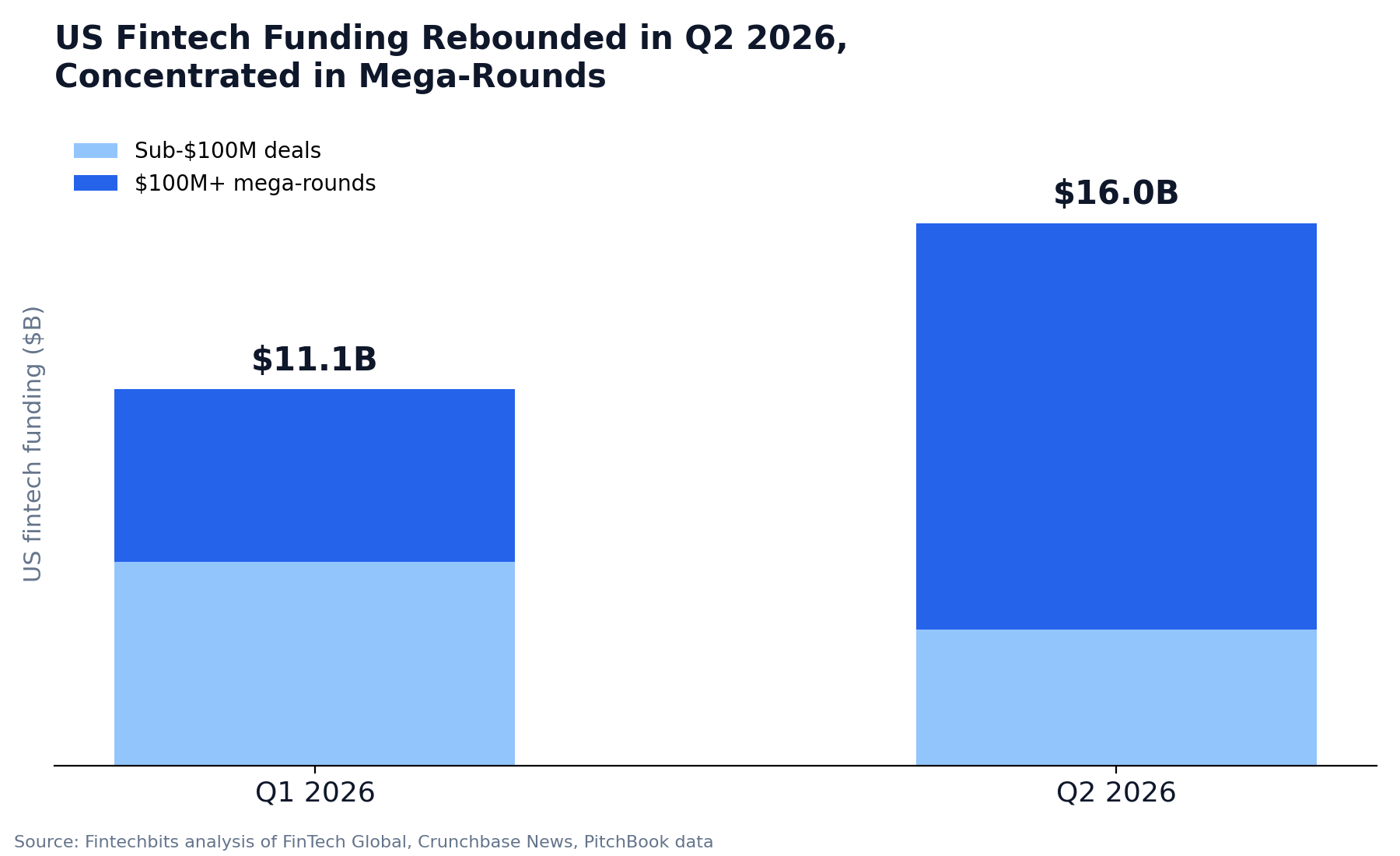
US fintech companies raised $16 billion across 445 deals in Q2 2026. That is the strongest quarter for fintech funding in five quarters, up 44% from Q1, and it happened without a broad recovery in deal volume, which rose just 4%. The money didn’t spread out. It concentrated.
That single fact is the story of fintech in Q2 2026: a market that looks healthy from 30,000 feet and looks a lot more selective up close. Eleven new fintech unicorns were minted this quarter, matching the highest quarterly count since Q2 2022. At the same time, the sector logged nearly 10,000 job cuts so far this year as firms restructure around AI. Both things are true at once, and neither cancels the other out.
This is Fintechbits’ first quarterly State of Fintech report, and we built it because nobody else is doing this specific job well. Finextra publishes an annual State of Fintech in Europe. Fintech Futures and The Fintech Times both cover deals as they happen, deal by deal, week by week. None of the three is stitching funding, M&A, IPOs, regulation, and sector trends into a single quarterly read. We’re going to do that every quarter, starting now.
The funding rebound, and where the money actually went
Start with the split. Deals under $100 million totaled $4.3 billion in Q2. Deals of $100 million or more totaled $12 billion, up 23% quarter-over-quarter and more than double the $5.1 billion in mega-round activity seen in Q1. Investors didn’t write more checks this quarter. They wrote bigger ones, and they wrote them to companies that had already proven they could scale.
The mega-rounds tell you where conviction actually sits right now:
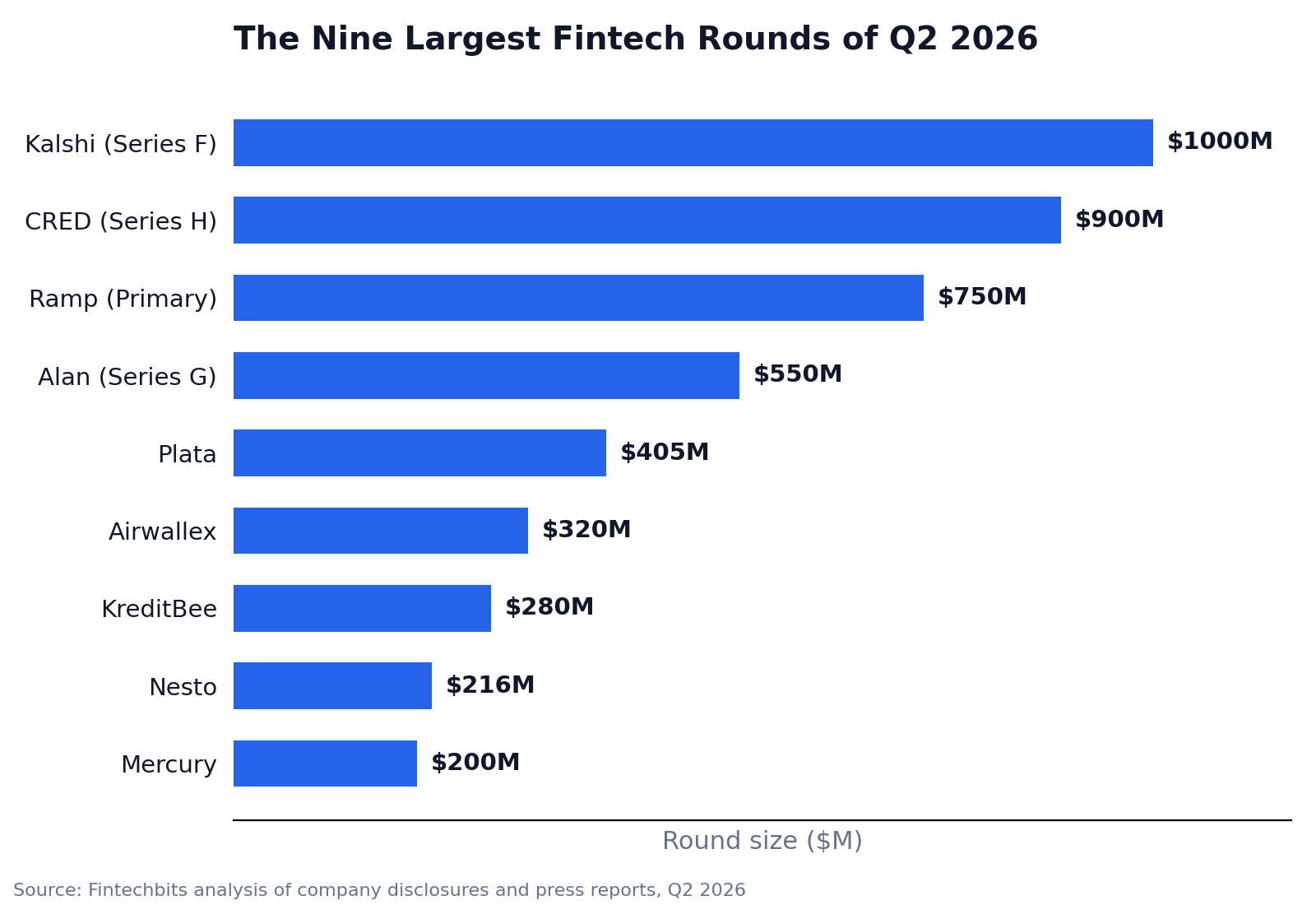
- Ramp raised $750 million in primary financing led by ICONIQ, GIC, and Ontario Teachers’ Pension Plan, pushing its valuation to $44 billion. Expense management and corporate cards remain one of the few B2B fintech categories where growth-stage investors are still writing nine-figure checks without hesitation.
- Kalshi closed a $1 billion Series F led by Coatue, with Sequoia, Andreessen Horowitz, IVP, Paradigm, Morgan Stanley, and ARK Invest all participating. Prediction markets went from regulatory gray area to institutional-grade in under two years.
- CRED raised roughly $900 million in a Series H led by Meta, a notable entrant into fintech venture investing.
- Airwallex raised $320 million at an $11 billion valuation, and Alan closed a $550 million Series G at $6.3 billion, both signs that cross-border payments and insurance infrastructure are still attracting growth capital at scale.
- Mercury ($200 million, $5.2 billion valuation), Nesto ($216 million, new unicorn at $1.4 billion), Plata ($405 million, $5 billion valuation as Latin America’s most valuable private digital bank), and KreditBee ($280 million, $1.5 billion valuation) rounded out a quarter where challenger banking and consumer credit both found real capital outside the US.
The through-line: capital went to companies with distribution, revenue, and a plausible path to an exit, not to concepts. That is a change in posture from the zero-rate years, and it looks durable rather than cyclical.
M&A: incumbents are buying instead of building
The defining deal of the quarter was strategic, not venture-backed. Capital One completed its $5.15 billion acquisition of Brex, the AI-native corporate card and expense management platform, folding real-time payments and workflow automation directly into a major bank’s stack. That is a bank buying software-company velocity because building it in-house was going to take too long and cost more.
Expect that logic to repeat. Traditional financial institutions are sitting on balance sheets that can absorb $1 billion-plus acquisitions, and the fintech companies that spent the last five years building embedded finance, payments orchestration, and AI-native workflow tools are exactly the assets banks need and don’t have time to replicate. Capital One-Brex wasn’t the only signal: payments infrastructure provider NMI acquired Dwolla in May, adding account-to-account payments, real-time rails, FedNow connectivity, payouts, and open banking capability to its embedded-payments stack in a single move rather than building each piece internally. M&A activity across payments and embedded finance has been building through 2026, and Q2 looked like the moment it stopped being theoretical.
The dealmaking wasn’t confined to enterprise software either. Nuvei agreed in June to acquire cross-border payments company Payoneer for $2.75 billion in cash, a $7.40-per-share offer that pairs Payoneer’s marketplace and freelancer distribution with Nuvei’s processing stack. Barclays, meanwhile, agreed to buy GoHenry, the UK children’s banking app, in a deal expected to close in Q4, a bet that owning the pipeline of future adult customers starting at age six is worth more than building that product internally.
Embedded finance and open banking: the quiet infrastructure war
While the mega-rounds and the Capital One deal grabbed headlines, the more structural story of Q2 was consolidation underneath the surface. Embedded finance, banks and fintech capability showing up inside e-commerce platforms, payroll systems, and vertical SaaS rather than standalone apps, is projected by McKinsey to generate more than $7 trillion in global revenue by 2030. That number is why NMI wanted Dwolla and why banks want Brex-style infrastructure: the distribution layer is moving to whoever owns the platform the customer is already using, not whoever owns the balance sheet.
Open banking is following the same arc, extending from checking-account data sharing into open finance, covering investments, pensions, and insurance under one consent framework. That matters directly for wealthtech and lending: a lender or robo-advisor that can see a customer’s full financial picture underwrites faster and prices risk more accurately than one working from a bank statement alone. Real-time payments are becoming the default rail underneath all of it, which is quietly rewriting fraud economics as settlement windows shrink from days to seconds.
IPO watch: the pipeline is finally moving
Stripe is in its IPO roadshow following a February 2026 S-1 filing, targeting a valuation around $170 billion after raising $9.4 billion privately. It is the single most consequential fintech listing in years, and it’s a live test of whether public markets will pay up for payments infrastructure the way private investors have for a decade.
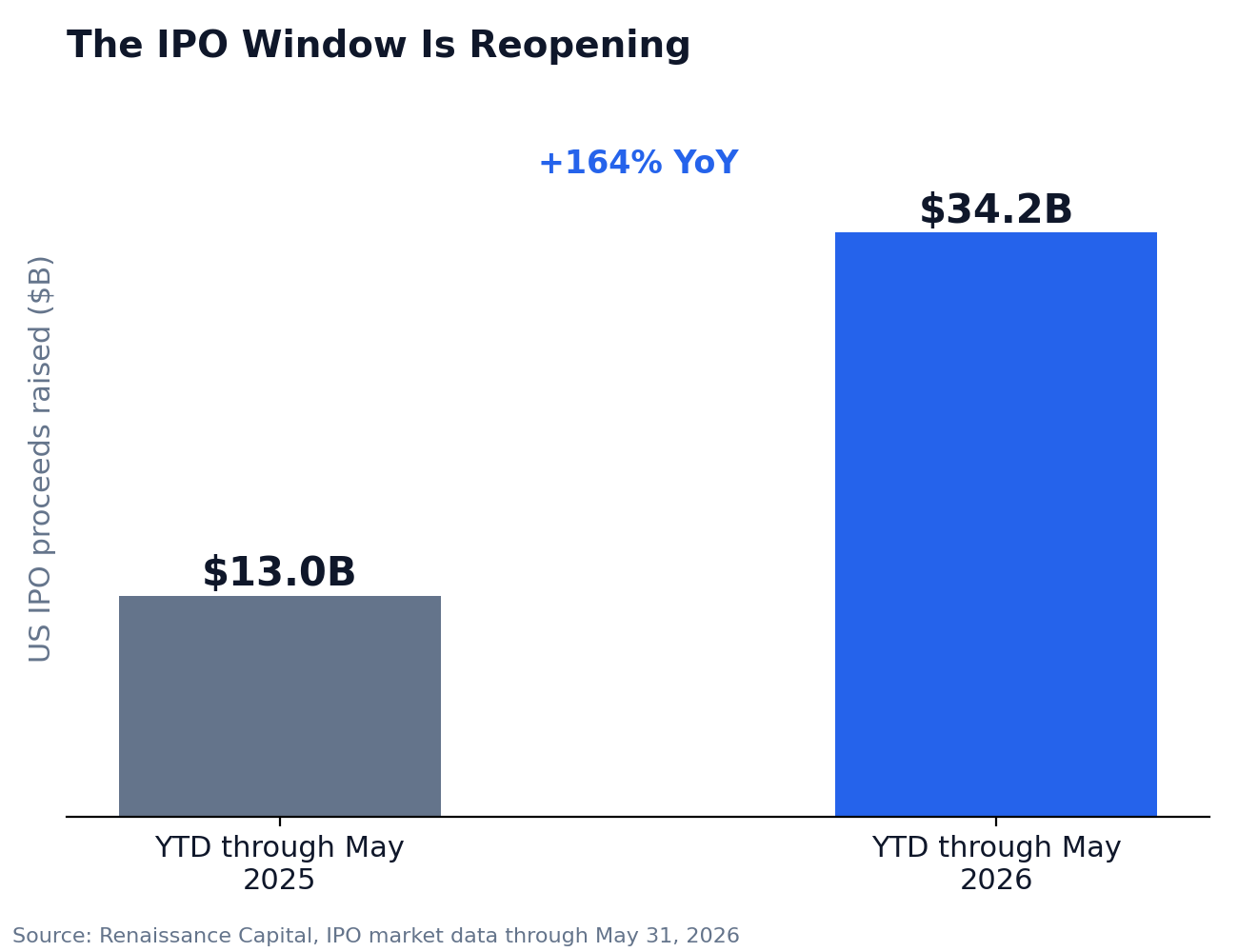
Revolut is preparing its own public listing later this year. Broader IPO markets are cooperating: through May 31, US IPOs had raised $34.2 billion year-to-date, up 164% versus the same period in 2025, across 113 total listings.
More than 200 fintech unicorns are still sitting on the sidelines, including Plaid, Airwallex, Kraken, Starling, Wealthsimple, and Ramp. If Stripe’s roadshow prices well, expect the queue to move faster than most people are currently planning for.
Stablecoins grew up this quarter, whether the industry was ready or not
The stablecoin market hit a record $322 billion in June, with USDT alone accounting for roughly $160 billion of that. But size wasn’t the quarter’s real story. Regulation was.
MiCA’s July 1 enforcement deadline forced Coinbase, Kraken, Crypto.com, and Binance’s EU entity to delist USDT for EU and EEA users, splitting the stablecoin market into a compliant tier and a shrinking non-compliant one. In the US, the FDIC, Federal Reserve, OCC, NCUA, and FinCEN jointly advanced rulemaking under the GENIUS Act that would require stablecoin issuers to run bank-grade customer identification programs. Seven major economies, the US, EU, UK, Singapore, Hong Kong, UAE, and Japan, now mandate full reserve backing, licensed issuance, and guaranteed redemption. That’s regulatory convergence happening in real time, not in a five-year plan.
Card networks are racing to own that convergence through acquisitions as much as standards. Mastercard’s agreement to acquire stablecoin infrastructure firm BVNK for up to $1.8 billion, first announced in March and still working through regulatory approval, remains the largest stablecoin acquisition on record and signals that Mastercard wants to own settlement infrastructure directly rather than simply plug into whichever standard wins.
The industry’s response arrived on June 30, when the Open Standard consortium launched Open USD (OUSD) with more than 140 founding partners, including Visa, Mastercard, Amex, Stripe, BlackRock, Coinbase, and Google. When that list of names agrees to back a shared standard, it’s a signal the biggest players expect stablecoins to be permanent payments infrastructure, not a crypto-native side project.
The other side of the ledger: layoffs and a genuinely bifurcated market
None of the above should read as an unqualified boom. The fintech sector has logged at least 9,706 job cuts in 2026 as companies restructure around AI and tighten margins. Robinhood is cutting roughly 10% of its workforce, about 290 roles, while flattening management layers. PayPal has signaled workforce reductions of up to 20% over three years. These are not distressed companies. They are profitable ones reallocating cost structure toward automation.
That is the real shape of fintech right now: capital concentrating in fewer, larger, later-stage bets while headcount contracts even at companies posting strong growth. If your fintech is mid-stage and not yet at the scale where you’re either raising a mega-round or getting acquired, Q2 2026 was a harder quarter than the headline numbers suggest.
Sector notes: insurtech, BNPL, and the AI shift from pitch to plumbing
Insurtech funding hit $1.63 billion in Q1 2026, up 27% year-over-year, with AI-labeled companies capturing 95.2% of total investment, the highest share on record. That trend held into Q2, with Taktile’s $110 million Series C, led by Goldman Sachs Alternatives to back agentic claims and underwriting automation for banks and insurers, among the quarter’s larger insurtech deals. The pattern across insurtech, and frankly across fintech broadly, is that AI stopped being the pitch and became the plumbing. Investors are funding measurable claims automation and underwriting improvements, not AI narratives.
BNPL kept growing but kept decelerating: global payment value growth is projected to slow from 19.2% in 2025 to roughly 14% in 2026 as the category matures from growth engine into standard checkout option. Affirm still posted a 36% year-over-year jump in gross merchandise volume for its fiscal Q2, proof the category has room left, just not the hypergrowth of 2021.
Three things to watch heading into Q3
First, the Stripe IPO outcome will set the tone for every fintech unicorn deciding whether to file this year or wait another cycle. Second, GENIUS Act rulemaking will finalize enough that stablecoin issuers know their actual compliance burden, which should either accelerate or freeze new entrants depending on how heavy the final rules land. Third, watch whether the Capital One-Brex model of bank-buys-fintech repeats at a similar scale; one deal is a data point, two or three is a trend that resets how growth-stage fintechs think about their own exit path.
We’ll be back with the Q3 2026 edition in October. If there’s a dataset or sector you think we should track more closely next quarter, tell us. This report exists because nobody was building it.
Methodology: figures in this report are compiled from public reporting by FinTech Global, FinTech Futures, Crunchbase News, PitchBook, CB Insights, Renaissance Capital, and company disclosures covering April through June 2026. Deal figures reflect announced or completed transactions as reported at time of writing.
