

Author: Kartik Chugh, Cofounder, FORKOFF
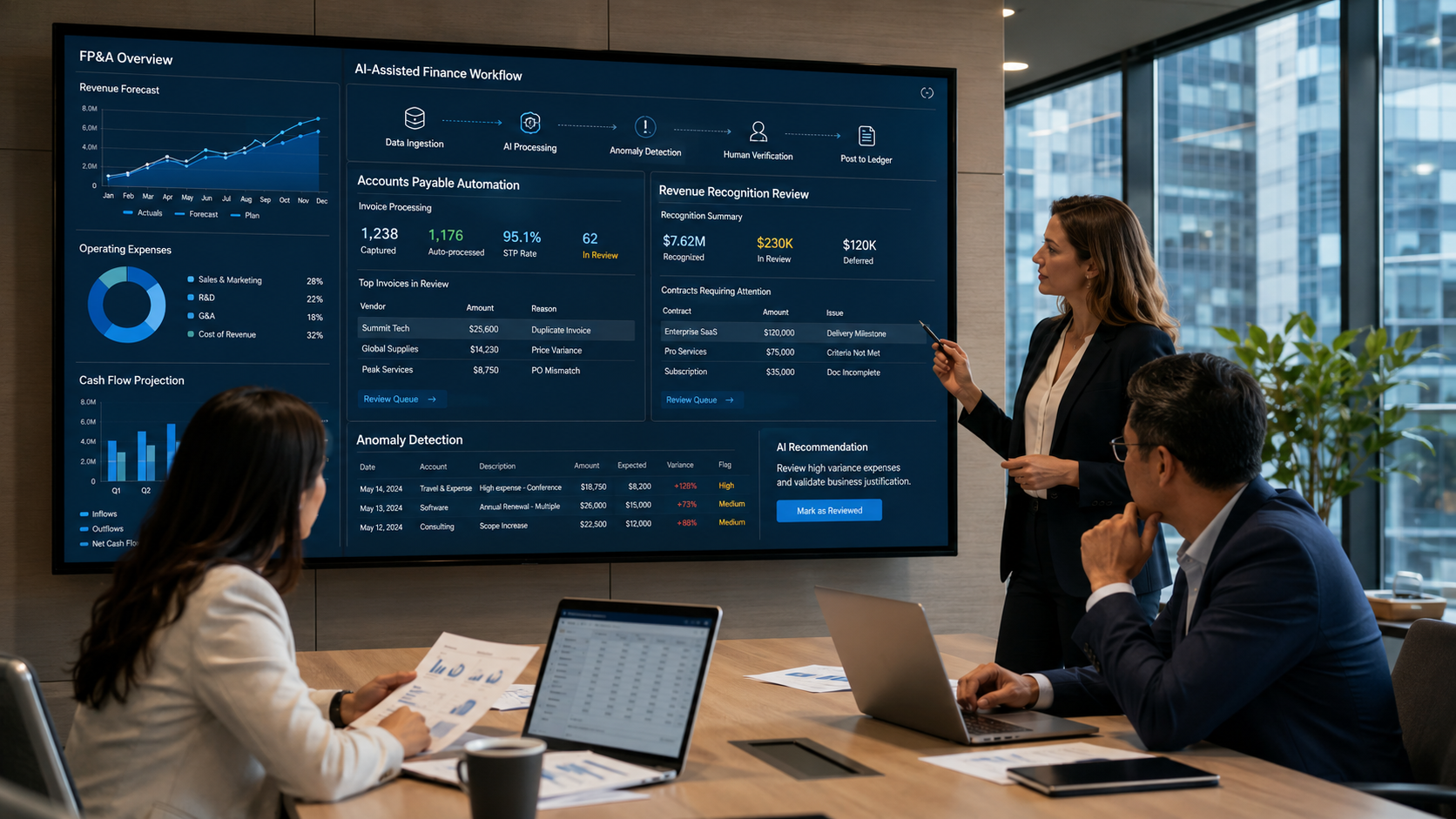
AI finance jobs are shifting faster than the operating models built around them, and that gap is where the damage shows up. Last quarter, a Series B fintech CFO walked us through her month-end close. Her FP&A lead had spent 14 of the prior 30 days on variance commentary, the narrative paragraphs that sit under every line item in the board pack. She wired GPT-4 into the variance step three months earlier and clawed back 9 of those 14 days. Then her auditor flagged a $217K reclassification the model had quietly smoothed over in a footnote. The lesson was not that AI failed. Instead, her team’s workflow had not caught up to what the model was doing. More than half of finance functions now run AI in some form, a shift fintech teams have tracked closely across the sector. Across the 11 finance-led engagements we ran in the last 9 months at FORKOFF, that same gap kept showing up, because tools moved faster than the operating model around them.
Which AI Finance Jobs Are Changing Fastest
Three roles are getting rewired fastest, and the broader move toward AI in finance only speeds it. Stanford research on AI in accounting found the technology mostly absorbs repetitive work, not headcount, which matches what we see.
The FP&A analyst is the most visible of these AI finance jobs. Work that once took five days, pulling actuals from NetSuite, normalizing against budget, drafting variance commentary, now compresses into 8 to 12 hours when Claude or GPT-4 sits next to a tagged general ledger. AI eats the high-volume, low-judgment middle first, so normalization, first-draft commentary, and schedule generation move to the model. What it does not eat is the analyst defending a number to a CFO who has seen 14 closes and knows the smell of a smoothed reclassification.
The accounts payable specialist comes second. Invoice triage, GL coding, and duplicate-exception handling now sit inside AP automation layers like Ramp, Brex, and Tipalti. One client cut AP headcount from 4 to 1.5 over 18 months, and the remaining 1.5 handle exception negotiation, not data entry. A 2025 CFO survey from L.E.K. reached the same conclusion, since AI reshapes the finance workforce rather than wiping it out, and transaction-heavy roles automate first.
The third is the technical accountant on revenue recognition. ASC 606 contract review, once a 6-week grind on every complex deal, now starts with a model pass that flags performance obligations and pulls candidate language. The accountant moves from drafter to reviewer. That sounds smaller. It is not. Review-first work compounds differently, so those who learn the new mode early outearn those who do not. We documented the same pattern on the GTM side in our agent-native GTM founder stack writeup. These AI finance jobs shift the same way: routine moves to the model, judgment stays human.
The New AI Finance Jobs Emerging Inside Orgs
Three roles are appearing inside finance orgs that did not exist two years ago, and they are the fastest-growing AI finance jobs in the function.
The first is the finance AI gatekeeper. This person owns the policy layer: which tools get approved, which data classes can leave the four walls of the ERP, which workflows require a human gate before output ships to an external party. At companies above $50M ARR, this is increasingly its own seat, usually reporting into the controller. Below that line, it sits as a 30 percent slice of the FP&A manager’s job.
The second is the automation auditor. Someone has to verify that the AI-augmented monthly close did not silently introduce a $217K reclassification error. This person runs sampling routines, spot-checks model outputs against source documents, and writes the verification gates between model output and ledger entry. The same discipline already powers AI-driven fraud detection in fintech, where anomaly spotting still depends on a human reading the flags. In practice, a senior accountant who learned basic Python or SQL fills one of the newest AI finance jobs in the org.
The third is the finance prompt architect. Not the title, but the function. Someone owns the library of prompts the team uses for variance commentary, contract review, and schedule generation. They version the prompts, A/B test them against historical actuals, and retire the ones that drift. At FORKOFF we run a similar discipline on the GTM side, codified in our cold outreach cadence playbook.
What We Got Wrong At First
When we first wired Claude into the audit-ledger reporting cadence at FORKOFF, we made a specific mistake worth naming. We treated the model output as the deliverable. It is the single most common mistake teams make while redesigning AI finance jobs. Across the first 6 weeks of weekly client audit reports, we shipped 4 reports where the model had pulled stale figures from an outdated snapshot of the GTM dashboard. The report read clean enough that nobody on our side caught it on review. Two clients caught it. One did not, so the report sat in their board pack for a week before we surfaced the correction.
Then we changed the process. Every AI-drafted artifact at FORKOFF now passes a 4-point verification gate before it leaves the building. Correctness against source, voice-fit, evidence chain, attribution. The gate adds 18 minutes per report. So far it has caught 23 stale-source errors in the 9 months since we shipped it. Finance teams learn the same lesson the hard way, because the model is the first draft, not the deliverable. That single reframe sits at the center of how AI finance jobs really work now.
Skills The New AI Finance Jobs Demand
Three skills matter, named specifically.
First, finance professionals need the reflex to evaluate model output for stale-source hallucination. Models trained on public data will confidently cite a tax rate from 2022 in a 2026 memo. So before trusting any number the model produced, the professional has to ask what underlying source the model pulled from and whether that source is current. This is not AI literacy. It is closer to the discipline a senior auditor applies to a junior’s workpaper.
Second, they need the ability to write a verification gate. Not in the abstract. In practice this means writing a checklist of 4 to 7 items that a human runs against every AI-produced artifact before it ships. Does the variance commentary cite a source line item from the current period actuals? Does the contract review flag every performance obligation by section number? Does the schedule reconcile to the trial balance to the dollar? The professionals who learn to write these gates become indispensable.
Third, they need to negotiate scope with an AI-augmented vendor. Pricing models around AI tooling are still in flux, and vendors quote against assumptions that often do not hold. A finance professional who can read a usage-based contract, model the unit economics, and push back on the assumptions is worth a full headcount. We see the same pattern across our founder-led growth engagements, where the finance buyer gates a six-figure annual contract.
The gap here is wide. Fortune reported that while 88 percent of finance leaders call AI the most transformative trend ahead, only 8 percent feel very prepared to manage it. That readiness gap is where the new AI finance jobs get created.
The Limit AI Finance Jobs Still Cannot Cross
The work that does not compress is the work that demands human judgment under genuine ambiguity. Regulatory questions where the guidance is silent or contradictory. Multi-stakeholder negotiations where the audit firm, the board, and management each want a different treatment. Board narrative framing where the same numbers tell three different stories and the CFO has to pick one. The moment-of-truth conversation with an auditor when something is genuinely wrong and someone has to walk through what happened.
AI compresses the middle of the finance workflow. It does not replace the top or the bottom. So the through-line across every one of these AI finance jobs stays the same: the professionals who understand that distinction build careers that compound through the next decade. That is the real story behind AI finance jobs right now. The tooling is not the moat. The judgment wrapped around the tooling is.
