

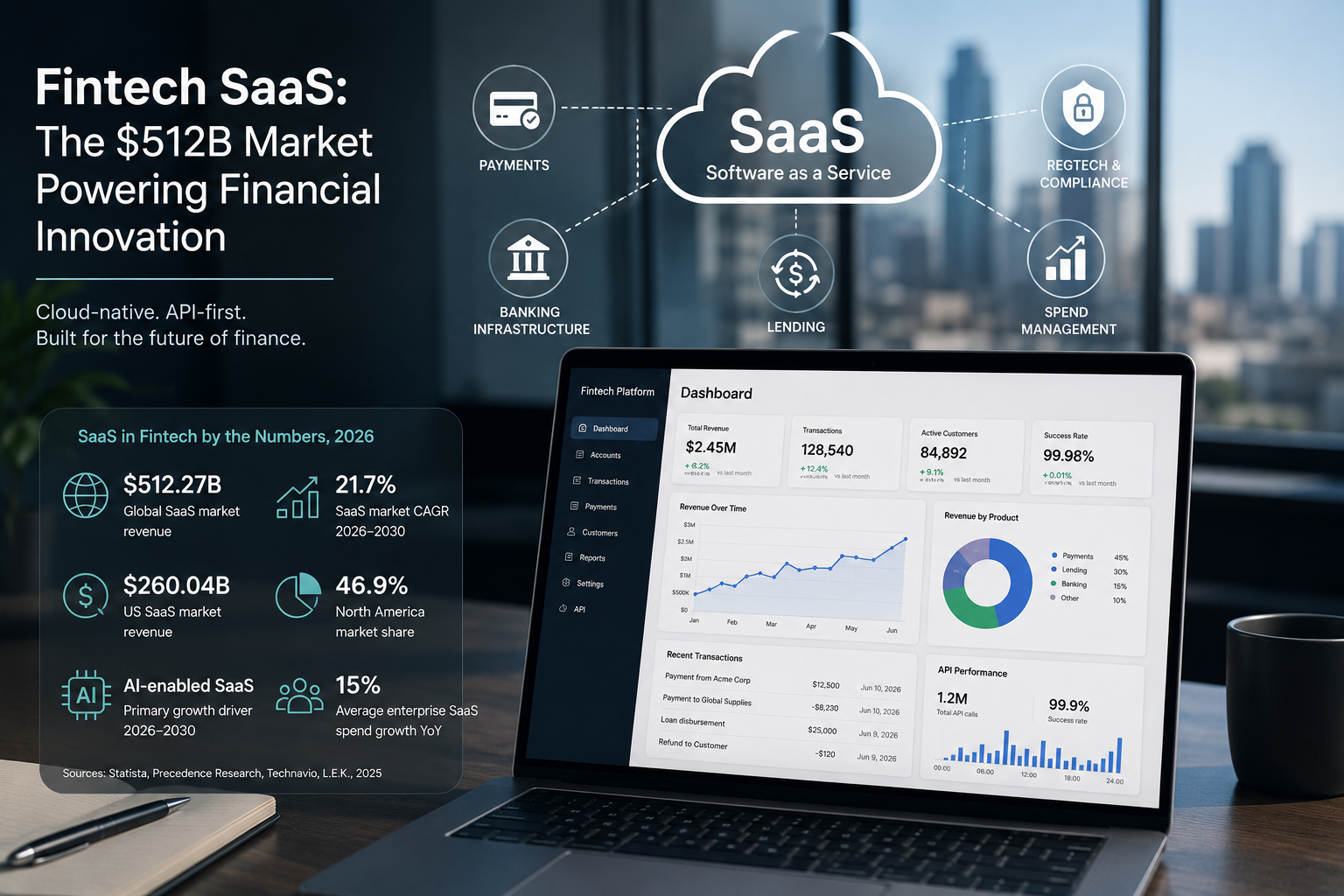
SaaS in fintech has rewritten how financial software reaches the people who use it. For most of the twentieth century, financial software shipped as a physical product: a disc, then a licence, installed on a local server, maintained by an IT department, and upgraded every three to five years in a project that usually ran over budget and behind schedule. That model is largely gone. In its place sits Software as a Service, software delivered over the internet on a subscription basis, reached through a browser or mobile app, updated continuously by the provider, and priced per user or per transaction rather than as a one-time purchase. The global SaaS market is projected to reach $512.27 billion in 2026, with the United States alone generating roughly $260 billion. So SaaS in fintech now anchors almost every category of financial product, from payments processing to risk management to regulatory compliance.
What Software as a Service Means
Software as a Service is a public cloud model that delivers applications over the internet on a subscription basis. Users reach the software through a web browser without installing or maintaining anything locally. So the buyer skips purchasing, installing, and patching, then focuses on using the product instead of managing it.
The three-letter label is so common now that it is easy to forget how radical it was when Salesforce pioneered it in 1999. Back then, enterprise buyers expected to own software as a capital asset. Salesforce’s pitch, that software could be rented by the month, reached through a browser, and updated invisibly without the customer’s IT team lifting a finger, met deep scepticism from an industry built around multi-year procurement cycles. That scepticism did not last. Today the rented model is the default, and SaaS in fintech is the clearest proof of how completely the idea won.
How SaaS in Fintech Differs From General SaaS
SaaS in fintech shares the delivery architecture of general enterprise SaaS, but it works under constraints the rest of the software world never sees. Financial software has to satisfy rules that generic tools can ignore: know-your-customer requirements, anti-money-laundering obligations, data residency rules, capital adequacy standards, and audit trails that log every action inside the system. So a platform built for a regulated institution embeds compliance at the architecture level, not as a feature bolted on later.
The second difference is the API. The market for SaaS in fintech was valued at $320 billion in 2024 and is projected to reach $724.87 billion by 2030 at a 14.6 percent CAGR, driven by rising demand for digital, cost-efficient, and scalable financial systems. The API is what lets one product plug into everything else an institution runs: core banking platforms, payment processors, fraud detection systems, and CRM tools. Stripe’s whole business rests on API quality, since a developer can add card processing to an app in a few lines of code without touching the card network underneath. Plaid connects user-authorised bank data to thousands of apps through a single API, quietly becoming the data layer of US retail fintech.
The Key Categories of Fintech Software
SaaS in fintech spans every layer of the financial stack. Payment processing tools like Stripe, Adyen, Square, and Braintree handle the complexity of accepting, routing, and settling payments for any business. Core banking platforms such as Temenos, Finastra, and Mambu supply the ledgers, account management, and transaction processing that banks and neobanks run on. Banking-as-a-Service providers, including Unit and Column, hand non-bank fintechs the regulatory and technical plumbing to offer banking products without holding their own charter.
Spend management is the category Ramp and Brex defined for US finance teams, bundling expense management, corporate cards, accounts payable automation, and AI-powered spend analysis into one cloud-native platform. Lending platforms such as nCino and Blend give banks and credit unions loan origination, underwriting, and portfolio tools. Regtech tools automate compliance monitoring, transaction surveillance, and regulatory reporting. Each slice shows the same pattern: SaaS in fintech replaces a heavy internal build with a service the institution simply subscribes to.
The Economics of the SaaS Model
SaaS in fintech changes the economics of financial software in three ways. For buyers, it turns a large upfront capital outlay into predictable operating expense. Instead of spending $5 million to buy and implement an enterprise banking system, an institution pays a subscription that scales with usage. For sellers, the subscription creates recurring revenue that is far steadier and more valuable than project or licence revenue, because a customer who renews every year carries a lifetime value a one-time sale never matches. For investors, recurring revenue with high retention earns premium valuation multiples, which is why pure-play SaaS companies trade at revenue multiples that would baffle a traditional software buyer.
Four numbers define SaaS financial health: customer acquisition cost, monthly recurring revenue, net revenue retention, and churn. Net revenue retention above 120 percent, where existing customers expand spending faster than churn erodes it, is the gold standard for enterprise SaaS and signals a product that is both sticky and growing inside its base. North America already holds close to 47 percent of the global SaaS market, and the AI layer is now the primary engine of further growth, as AI spreads across finance functions.
How AI Is Reshaping SaaS in Fintech
AI is the most consequential shift in SaaS in fintech right now. In its first phase, AI meant machine learning embedded in specific functions: fraud detection that scores transactions in real time, credit models that predict default, and language tools that automate document review. In its second phase, now underway, AI is becoming the primary interface. Users talk to the system in plain language instead of filling forms, and autonomous agents finish multi-step workflows without pausing for instructions at every turn. The broader move toward AI across finance is accelerating that change.
Ramp shows where this leads. In April 2026 the company launched a fleet of AI procurement agents that source vendors, review contracts, and run compliance checks with little human involvement, and investors now describe Ramp as leading in agentic AI for finance. So the line between a SaaS product and an embedded financial platform is dissolving, because AI lets these tools act on financial data rather than merely organise it. The companies that lead SaaS in fintech through 2030 will not be the ones with the prettiest dashboards. They will be the ones whose agents cut the most measurable time out of financial administration.
Fintechbits is a specialist publication covering financial technology, digital payments, and the regulatory and investment landscape across global markets.
